


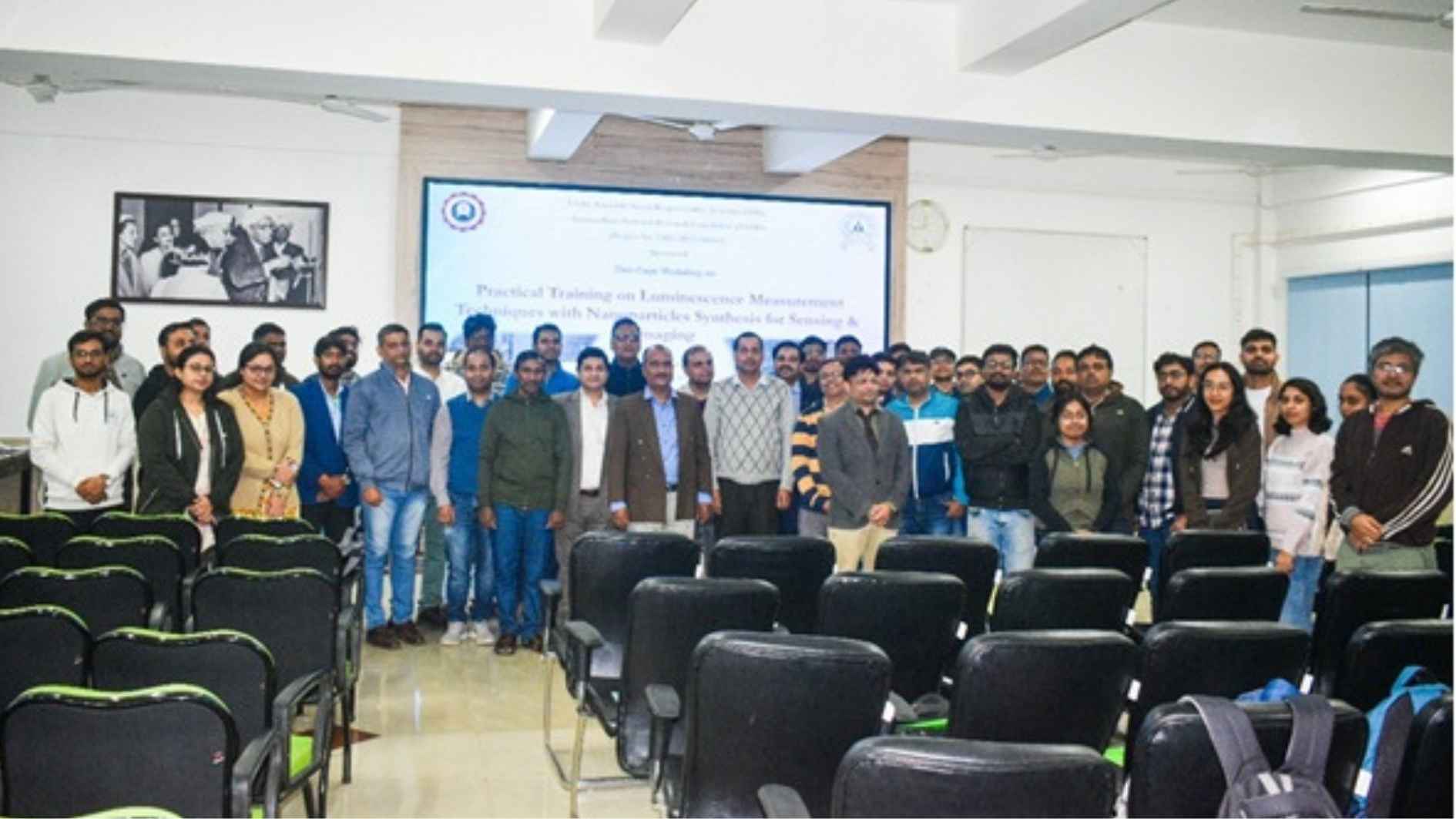
A two-day ANRF-sponsored national workshop on “Practical Training on Luminescence Measurement Techniques with Nanoparticle Synthesis for Sensing and Imaging” was held on December 14–15, 2025 at the Department of Physics of Indian Institute of Technology (Indian School of Mines) Dhanbad.
The workshop is being organized under the Scientific Social Responsibility (SSR) initiative of the Anusandhan National Research Foundation (ANRF), Government of India.
The workshop was inaugurated by Prof. Kaushal Kumar and has brought together researchers, faculty members, and students from various academic and research institutions across the country.
The programme aims to strengthen experimental skills and deepen theoretical understanding in the rapidly evolving areas of luminescence measurement techniques and nanoparticle synthesis, which are central to modern sensing, imaging, and photonic applications.
The inaugural session was held at Raman Hall, where speakers emphasized the growing importance of hands-on experimental training in materials science and nanotechnology research.
Addressing the participants, Prof. Vineet Kumar Rai, Head of the Department of Physics, highlighted the significance of luminescence studies and underlined the department’s expanding role in contributing to globally relevant research and advanced experimental education.
The technical sessions on the first day featured a lecture by Prof. Supratim Giri of NIT Rourkela on “Crystal Engineering of Upconverting Lattice: Applications and Fundamentals,” providing insights into the design and application of upconverting materials.
This was followed by an online lecture by Dr. Neeraj Kumar Mishra from IISER Mohali, who discussed steady-state and time-resolved photoluminescence spectroscopy, covering both foundational principles and advanced research applications.
In addition to lectures, the workshop placed strong emphasis on practical training. Participants were engaged in demonstrations on the synthesis of upconverting nanophosphors, along with hands-on sessions on upconversion emission measurements using CCD spectrometers.
These laboratory-oriented activities were designed to help participants directly apply theoretical concepts to real experimental setups.
The organizers noted that the workshop is intended to bridge the gap between theory and practice by enabling close interaction between students and leading scientists, while also providing direct exposure to advanced research instrumentation and techniques.
The programme will conclude with an open discussion session and a valedictory ceremony, offering participants an opportunity to reflect on their learning experiences and future research directions.