


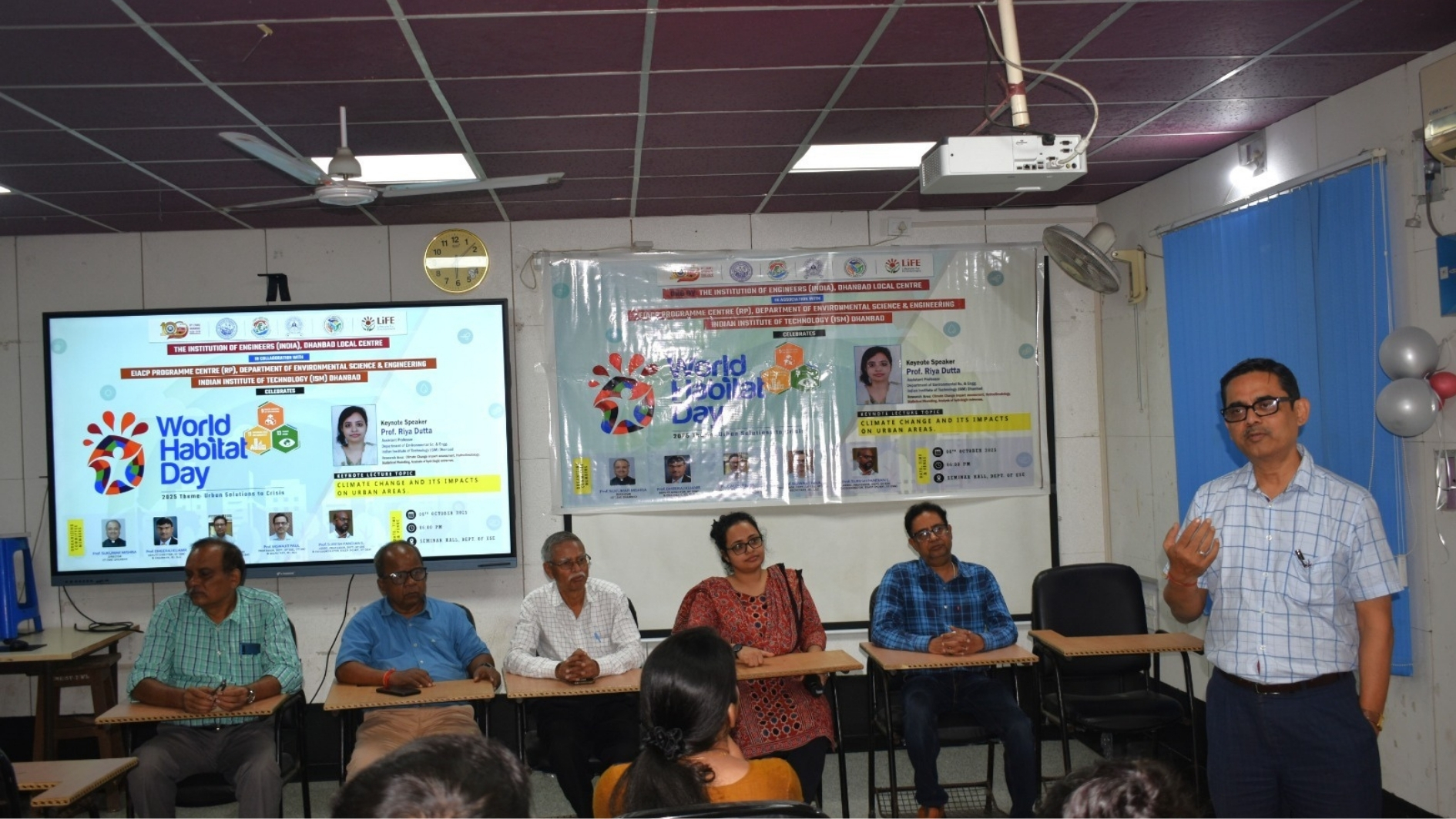
Theme: “Urban Solutions to Crisis” Highlights Sustainable Urban Development and Climate
Resilience The World Habitat Day 2025 was observed at the Department of Environmental Science & Engineering (ESE), IIT (ISM) Dhanbad.
The event was organized by The Institution of Engineers (India) [IEI], Dhanbad Local Centre, in collaboration with the EIACP Programme Centre (RP), Department of ESE, IIT (ISM) Dhanbad.
This year’s global theme — “Urban Solutions to Crisis” — underscored the urgent need for sustainable, inclusive, and long-term urban planning strategies to tackle issues arising from climate change, displacement, and rapid urbanization.
The observance highlighted the importance of shifting from emergency responses to development-oriented solutions that strengthen urban resilience and social equity.
The programme commenced with a Welcome Address by Prof. Biswajit Paul, Professor, Department of ESE, IIT (ISM) Dhanbad, and Secretary, IEI Dhanbad Local Centre. Prof. Paul spoke on the relevance of World Habitat Day as a platform to promote sustainable and inclusive urban development.
He emphasized that for a mining and industrial city like Dhanbad, urban growth must align with ecological sustainability and community welfare. Delivering the Inaugural Address, Prof. Alok Sinha, Head, Department of ESE and Coordinator, EIACP (PC-RP), IIT (ISM) Dhanbad, shared insights from his recent visit to the Dalma Wildlife Sanctuary.
He emphasized the importance of respecting natural habitats and advocated for the creation of animal corridors to ensure a balance between urban expansion and ecological conservation.
The session also featured a Keynote Lecture by Prof. Riya Dutta, Assistant Professor, Department of ESE, on “Climate Change and Its Impact on Urban Areas.” Prof. Dutta discussed the growing vulnerability of cities to extreme weather events such as heatwaves and flooding.
She stressed the significance of green infrastructure, wetland restoration, efficient stormwater systems, and community-level adaptation to make cities more climate-resilient and livable. The event provided a platform for fruitful discussions on sustainable urban living, climate resilience, and harmony with nature. It emphasized how academic research and community engagement can inform local actions and policy frameworks for a more sustainable urban future

