


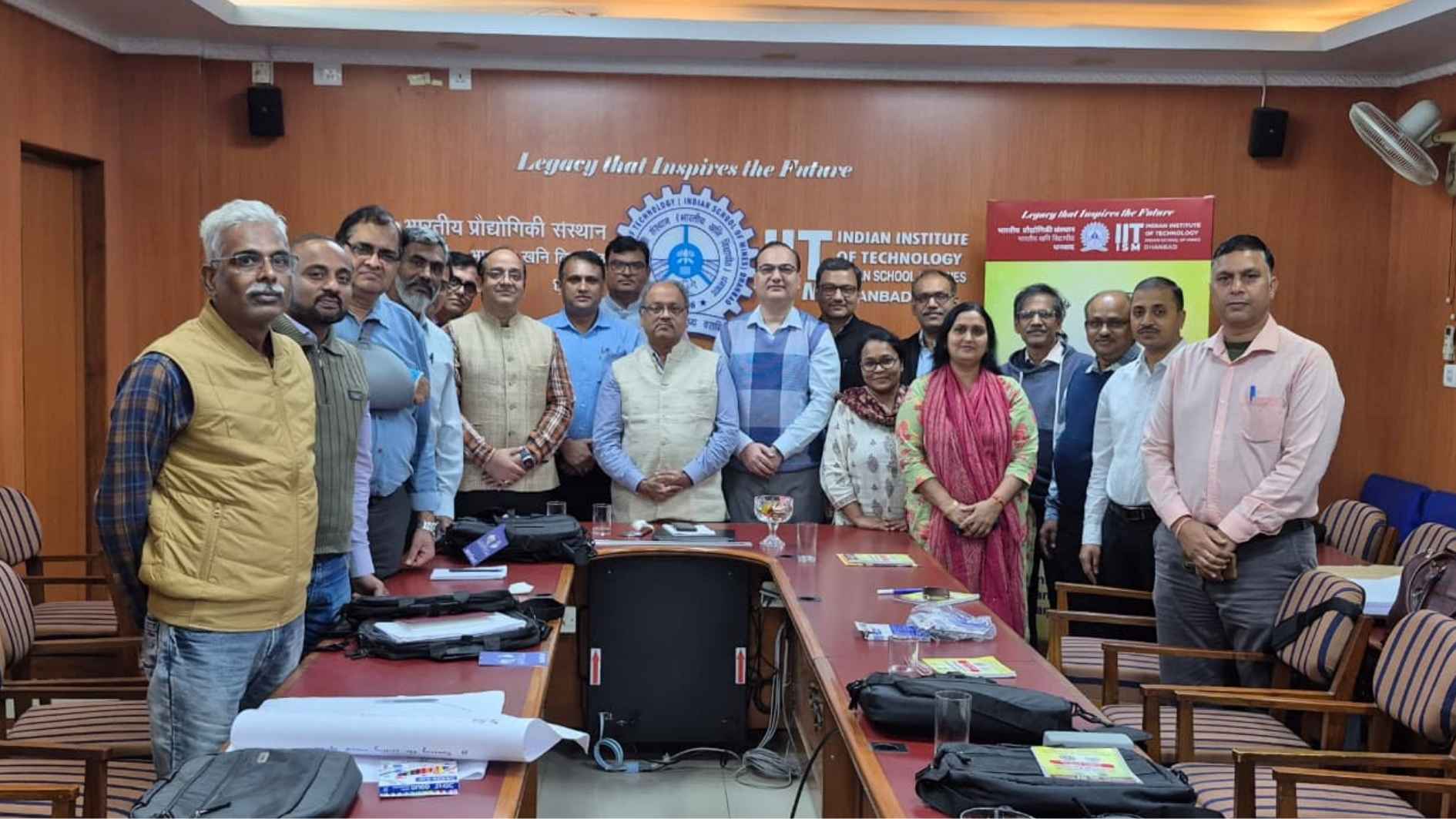
IIT (ISM) Dhanbad today organized a day-long training program under the Rashtriya Karmayogi Program at the Conference Hall of the Administrative Building, reinforcing the Institute’s commitment to strengthening a culture of Seva Bhav, accountability, and citizen-centric service. The programme witnessed the presence of Prof. Sukumar Mishra, Director, and Prof. Dheeraj Kumar, Deputy Director, along with senior Deans, former Deans, distinguished faculty members, and the Institute Registrar, Shri Prabodh Pandey.
The training was facilitated by Shri Ranti Dev Sharma, Joint Registrar (Lead Trainer), and Shri Sanjay Singh, Deputy Registrar (Master Trainer), who conducted a series of structured sessions designed to deepen administrative understanding, enhance behavioural competencies, and encourage a reflective approach to institutional functioning. Key academic leaders including Prof. Rajni Singh, Dean (Corporate Communications); Prof. Mritunjay Kumar Singh, Dean (Academic); Prof. Sarat Kumar Das, Dean (Faculty); Prof. Amit Rai Dixit, Dean (Infrastructure); and Prof. Keka Ojha, Dean (Continuing Education Program), along with other senior faculty members, actively participated in the programme.
The Rashtriya Karmayogi Program, a major national initiative, aims to transform traditional administrative practices into empathetic, efficient, and citizen-oriented systems. The training modules encouraged participants to reflect on their professional roles through situational exercises and team-based activities, emphasizing alignment of individual responsibilities with broader national objectives. Key themes of public service orientation, skill enhancement, professional accountability, and adoption of a citizen-first mindset were integral to the day’s proceedings.
The programme also emphasized the overarching vision of Mission Karmayogi, which promotes a sustained culture of continuous learning through digital platforms enabling flexible, anytime-anywhere capacity building. The cascading model—where Master Trainers subsequently mentor additional groups of participants—was highlighted as a mechanism to ensure consistent and long-term institutional impact.